
Restaurant Sunset — a solution to restore Malinska's glamour, familiar even to Henry Ford
If you've ever passed through Malinska, you've surely heard of Hotel Palace in Haludovo — the Las Vegas of Yugoslavia, today better described as Malinska's "problem".
In the late 1960s the Adriatic Highway was built, followed by the Rijeka Airport on Krk, drawing foreign investors and triggering a wave of hotel construction along the Adriatic. One of those hotels was Hotel Palace — the work of the renowned Croatian architect and academician Boris Magaš, indirectly funded by Bob Guccione (owner of Penthouse magazine), who poured 45 million dollars into construction and delivered a five-star hotel. It quickly became apparent that this was no ordinary hotel but a centre of decadence and gambling — Sodom and Gomorrah in one place. The "all-inclusive ticket" concept covered a private charter flight from the United States, France, or England — or a coach from Italy and Austria — the gambling tournament itself, accommodation, food, and drink: everything to bring lovers of the cards. The hotel's guest list is proof of how glamorous and sought-after it was at the time — from Saddam Hussein and Edson Arantes do Nascimento — "Pelé", who shot a Pepsi commercial there, all the way to Henry Ford Jr.
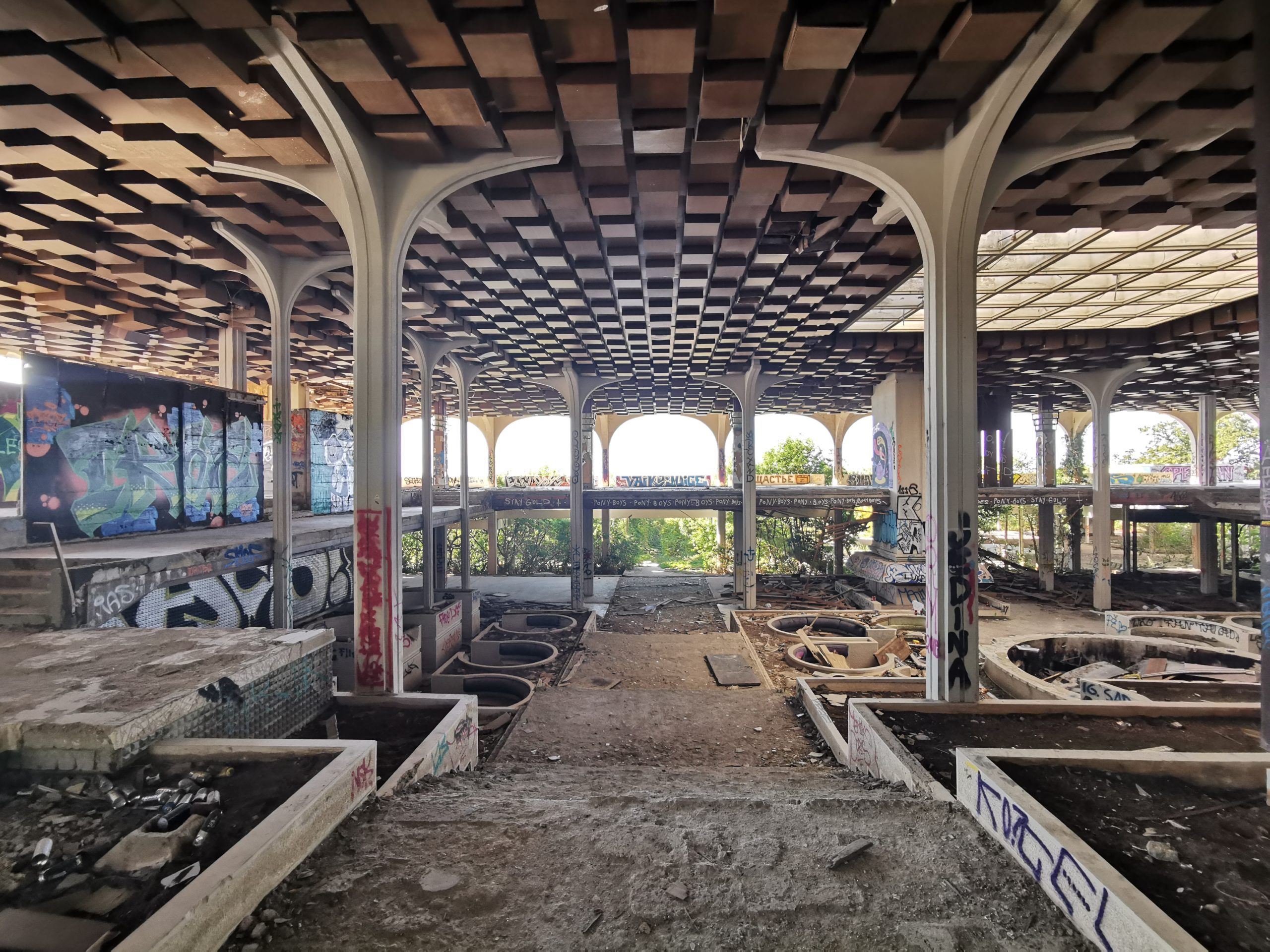
Unfortunately the hotel's glamour didn't last long. It went bankrupt within two years. Then came the war, tourism collapsed, and the hotel was repurposed as a refugee shelter. The hotel — or rather its ruins — is the consequence of the war and the country's privatisation. A glimmer of hope emerged when the Russian tycoon Ara Abramyan bought it, but in the twenty years since, not a cent has been invested in the building, and that glimmer of hope has turned into one of Malinska's most pressing problems.
How do you activate the entire complex while encouraging Abramyan to invest?
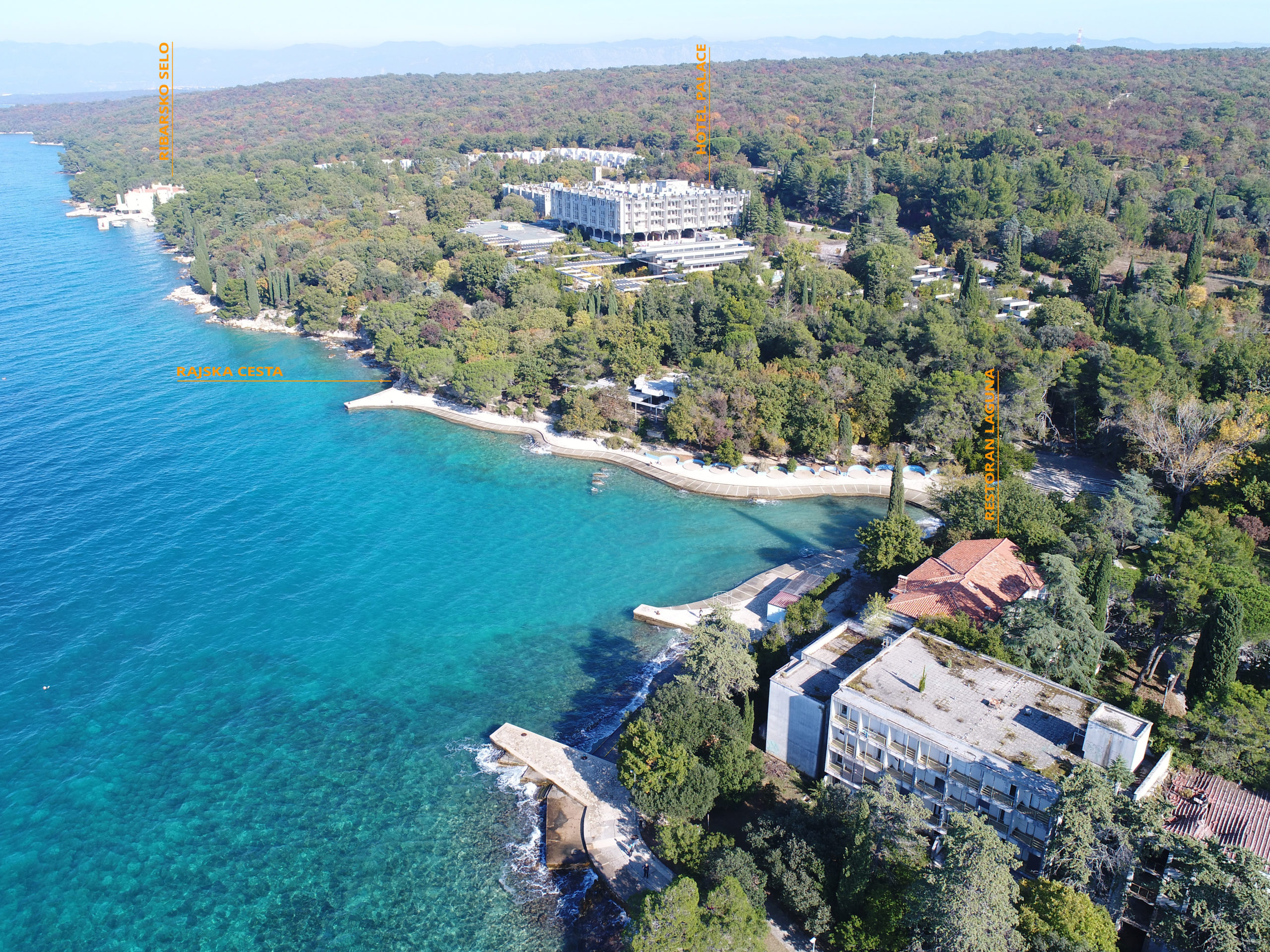
Abramyan's vision for the complex was 4–5 luxury hotels stretching along the coast under a closed concession. The stretch in question runs from the pier near Hotel Maestral to Ribarsko selo — a route that would cut the local population off from a familiar promenade, Rajska cesta, which continues all the way to Njivice.
But the vision proved impossible because:
- originally — and even during Palace's heyday — that stretch was never closed off, and everything still worked perfectly
- the local population objects, since closing the coastal walkway cuts them off from it
- the area is maritime domain (owned by the Republic of Croatia)
It is precisely in this research project that we tried to find a solution that might encourage both Abramyan and the Municipality of Malinska to begin developing the area — and that solution is Restaurant Sunset.
The project: Restaurant Sunset
Several entrances lead into the complex, but to us the most interesting — and the only viable one from the coast — is on the side opposite Ribarsko selo, where the former Restaurant Laguna stands. It is also derelict, but it is the only plot not owned by the tycoon.
The restaurant is compelling because of its position — a stunning view of the sunset that would draw plenty of visitors and could re-establish the link between the neglected hotel and the town of Malinska through the seaside walk. Revitalising the area would also signal to Abramyan that the municipality is willing to invest and to compromise, so the hotel can finally shine in its old glamour.
The restaurant concept
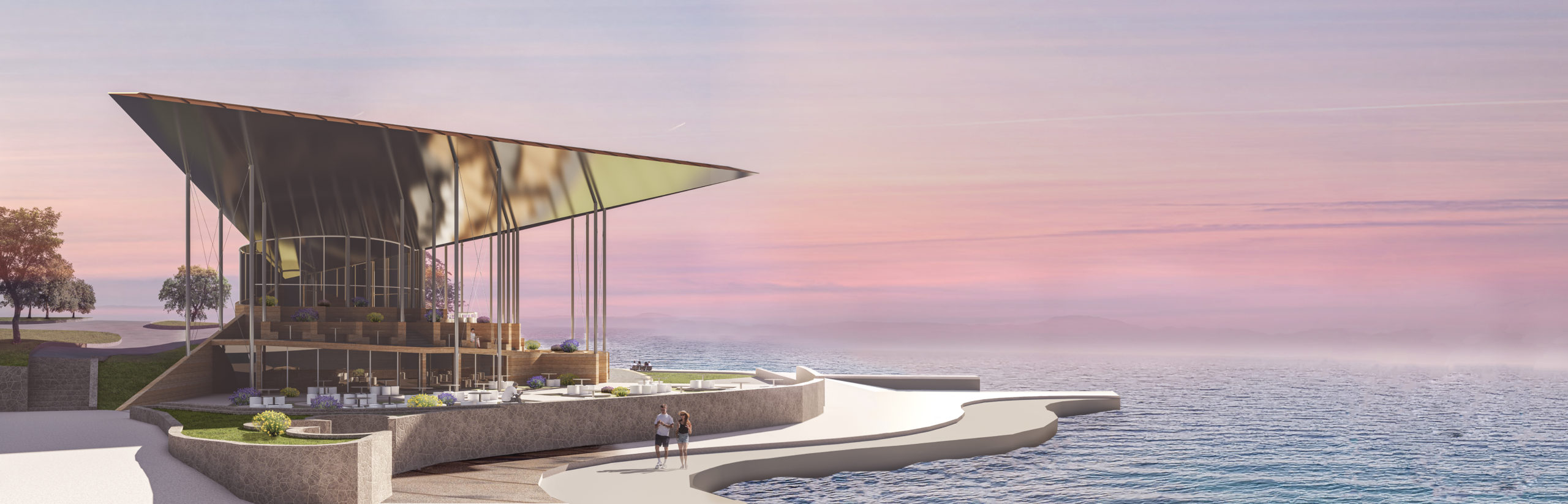
Restaurant Laguna would be demolished and replaced by an entirely new building — Restaurant Sunset — conceived as the conclusion of the hill. The plan is imagined as an inverted theatre with the audience facing the sunset, and the primary material is rammed-earth concrete, so that the restaurant reads as part of the hillside itself.
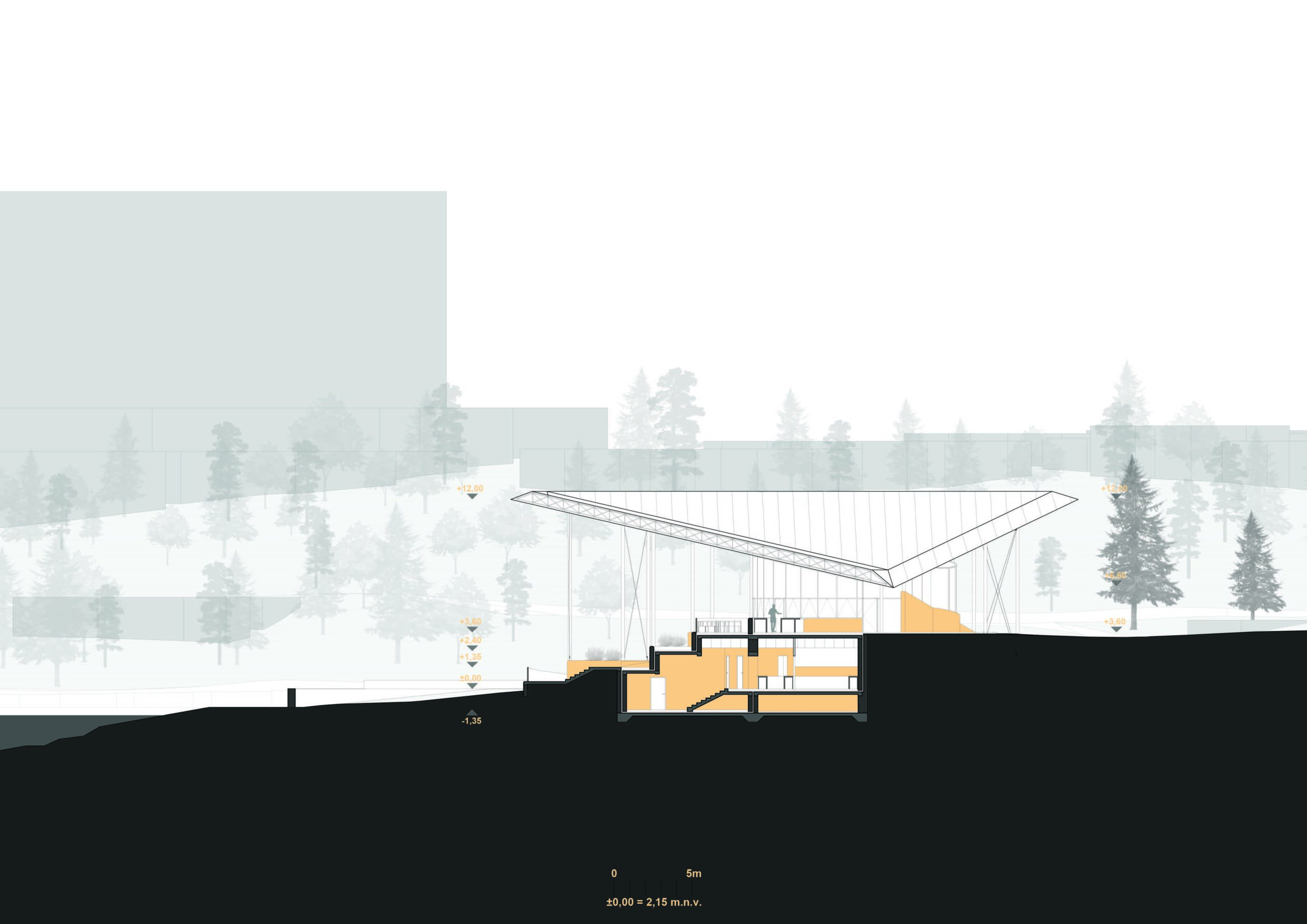
The restaurant consists of an upper enclosed level with the bar and a smaller terrace, opening onto a covered open-air section. Gentle ramps step down to the promenade and a lower café terrace set in a "field" of lavender. The ramps themselves are part of the design, leading to semicircular booths surrounded by native plants (lavender, rosemary, and the like), where guests can take in the sunset view, the scents of the plants, and ultimately the sound of the waves.
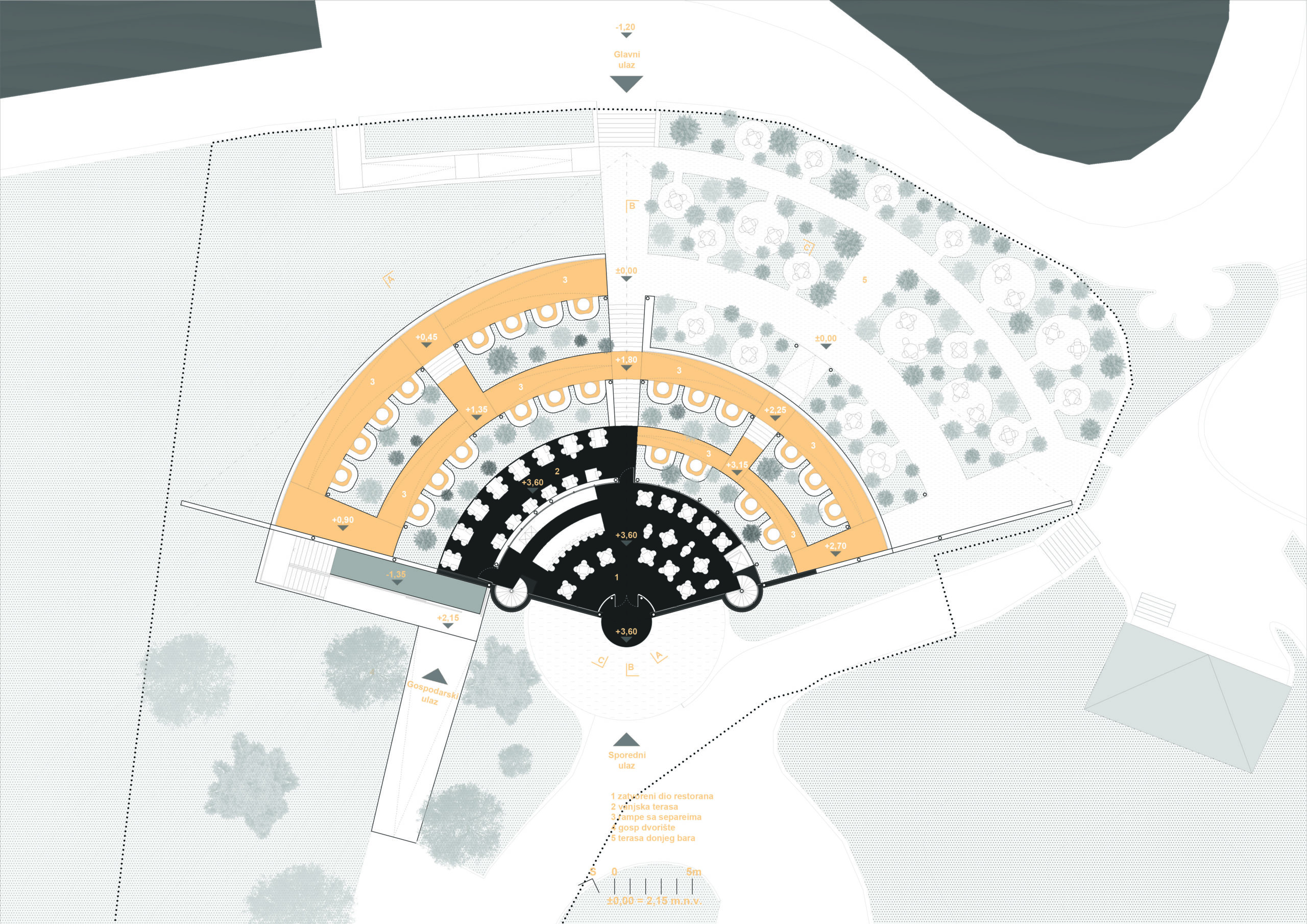
The restaurant would be quite complex and would read very differently from the front and rear. The rear reveals an immense roof — a single, light steel truss, sail-like, sheltering the restaurant from rain and sun. The front exposes the ramps and islands of booths, lavender, and rosemary.
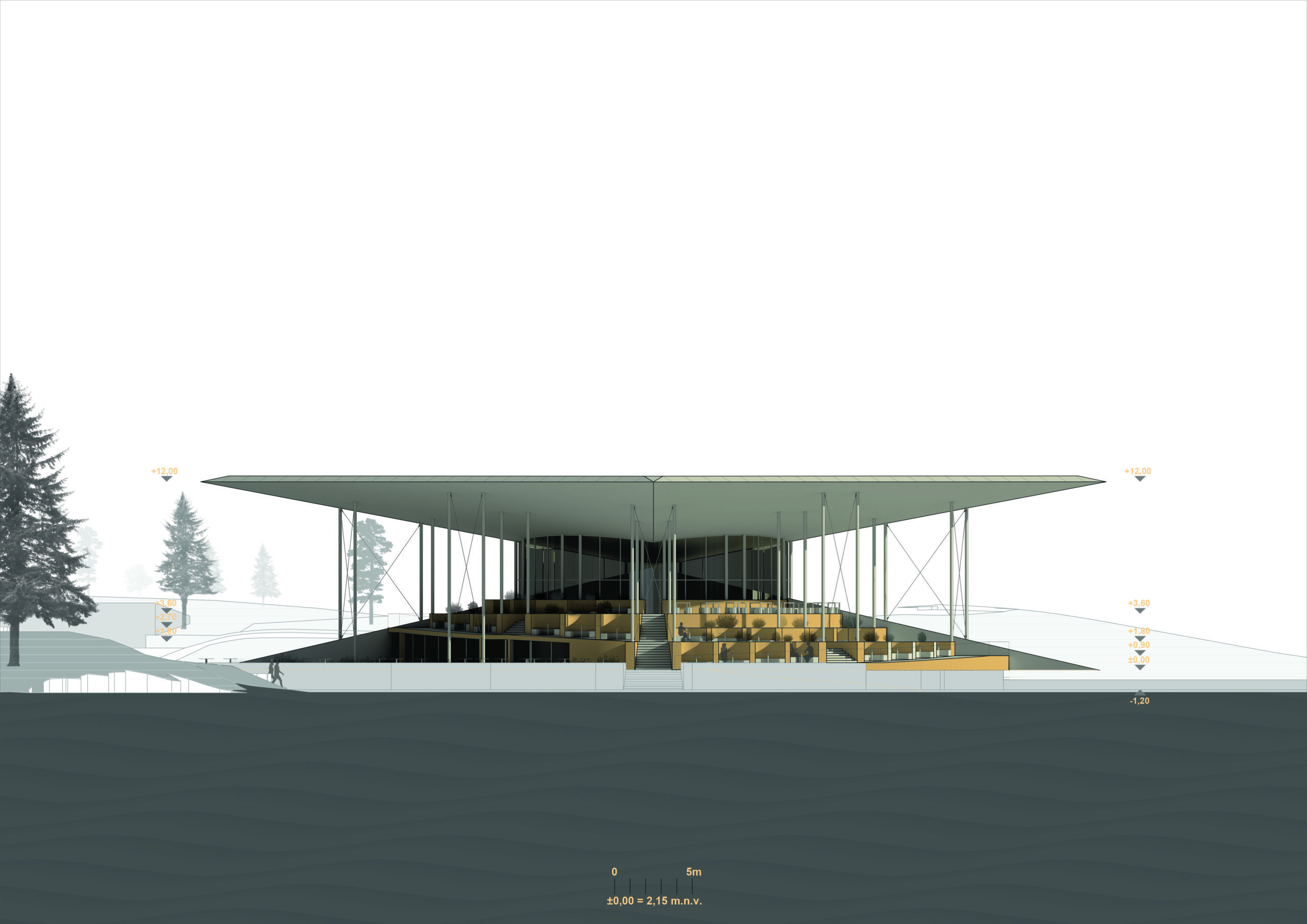
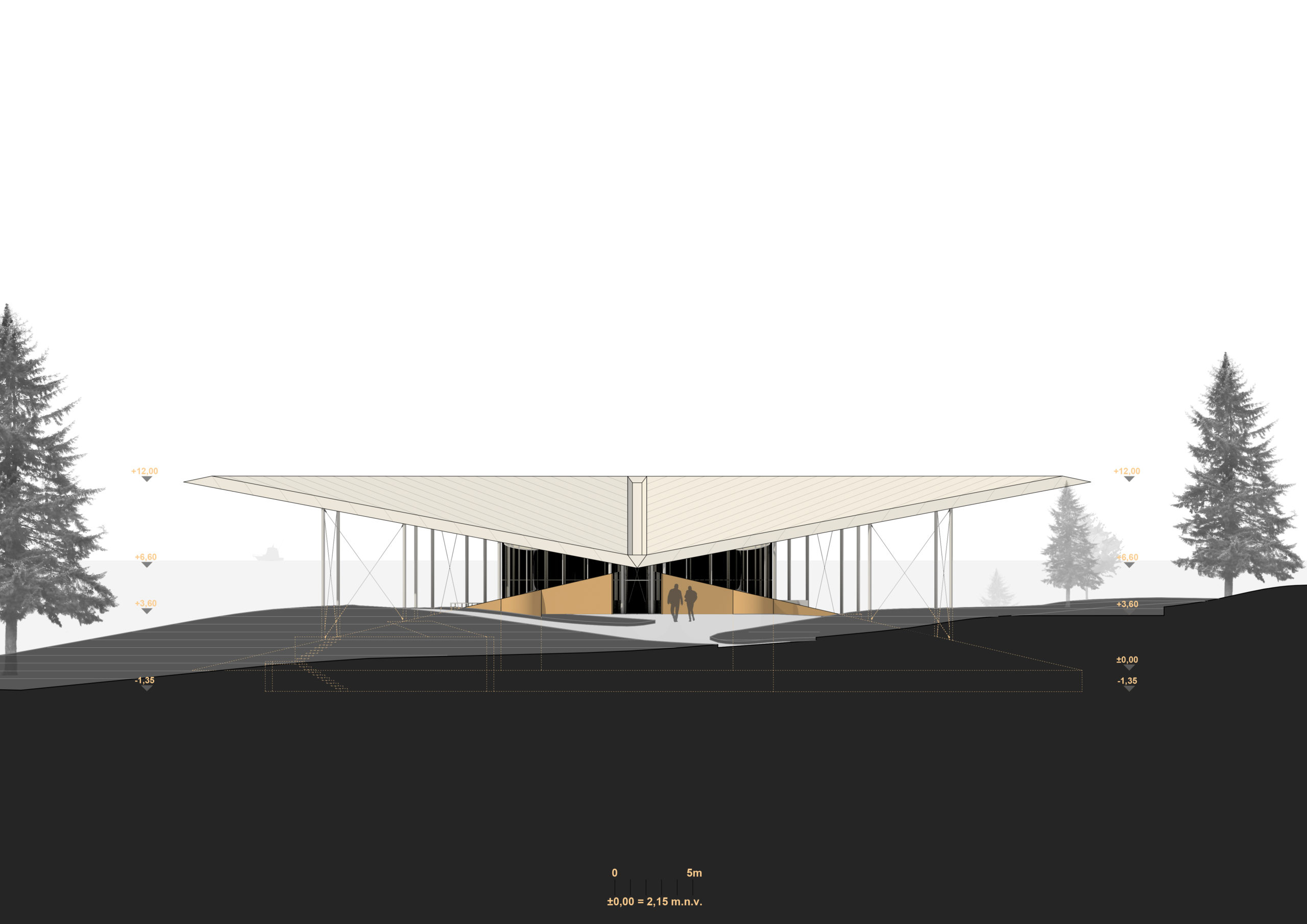
The roof, whose primary function is shelter, would also play a second role: its underside would be a mirror — polished stainless steel set on an angle — reflecting the sea. The restaurant as a whole would thus become a singular atmosphere composed of:
- the effect of the sunset view
- the effect of the scent of native plants
- the effect of the sound of the sea
- the effect of the rippling sea reflected overhead
We've built a grand narrative — and that was the goal: a much-talked-about restaurant that would draw enough visitors to set off the revitalisation of the Rajska cesta promenade itself (lighting, benches, waste collection, restrooms, kiosks, and so on). We didn't forget the "privacy" the owner demands either. The idea is to place a bridge along the axis of Restaurant Sunset, crossing the promenade by way of the sea and so giving exclusivity over a 200–400 m stretch.
The fate of Malinska and the Haludovo Palace Hotel
Whether Restaurant Sunset — or some other solution — will ever get its happy beginning remains to be seen. At the end of 2022, Malinska adopted a new spatial plan that restricts the development previously allowed, and the value of the Haludovo hotel complex fell from 50 million dollars to 10 million dollars.